
Brandon Klayme spent 18 months in jail for a crime he didn’t commit
From CBC NEWS


A legal expert says there were red flags during the investigation leading to a Nova Scotia man’s wrongful conviction that should have helped prevent it.
“I was livid,” said Gideon Christian, an associate professor of law at the University of Calgary, during an interview.
“This is basically what I spend a full semester warning my students against. It is just wrong.”
The investigation that led to Brandon Klayme’s conviction began in 2018 when the mother of a 12-year-old girl in Wisconsin discovered her daughter had exchanged sexual content with a man on the messaging app Kik.
Police in Wisconsin used the wrong Kik username in its investigation, leading Halifax Regional Police to arrest Klayme, believing his email and IP addresses were linked to the account.
Police arrested Klayme at his home in Dartmouth, N.S., in February 2020 and seized multiple devices from his home. He was charged with possession of child sexual abuse material, luring a child and making sexually explicit material available to a child.
Christian says the lack of evidence on Klayme’s devices is the biggest issue with the prosecution’s case – especially considering investigators would know exactly what messages to look for.
“There were 125 messages extracted from the victim’s cellphone,” Christian says, but they weren’t found on Klayme’s devices.
“Even if he deleted them, forensic analysis of his devices could have revealed deleted messages. None was revealed,” said Christian.
“That is a very strong indicator, at that point in time, that there is some problem proceeding with that case.”
Christian says the missing messages were the clearest red flag. But it’s not the only thing that went wrong during the investigation and trial.
After he was arrested, a Halifax Regional Police officer interviewed Klayme. The audio and video of those interviews are typically recorded.
“Unfortunately, there was a two-week period that, unbeknownst to anybody until the end of the two-week period … that that audio was not working on the system,” the officer testified.
Evidence related to that interview came from the officer’s recollection.
During the police officer’s testimony, the defence objected to her interpretation of some of Klayme’s responses. The officer later clarified her testimony.
“It is concerning, of course, that this evidence — the evidence of the interview — was not available,” said Christian.
He added, however, that he’s not sure how much that factored into the decision.
Halifax Regional Police noted in a statement to CBC News on July 29 that it was “a complex investigation as it began with a police agency in Wisconsin before the support of the Halifax Regional Police was requested.”
“In light of the court’s recent decision, we are committed to reviewing this file and our role in the outcome,” the statement said.
Christian says that another concerning element is the impact of Klayme maintaining his innocence during sentencing.
“Having been convicted, if you continue to assert your innocence, you are viewed as callous,” he said, adding this comes up in many cases of wrongful conviction.
At the conclusion of the sentencing submission, Klayme had an opportunity to make comments directly to the victim.
He told her that he was sorry for what happened to her but that he believed that another person was guilty.
“I can tell you convincingly that it did not help him,” Christian said.
Klayme spent 18 months in jail followed by 18 months probation.
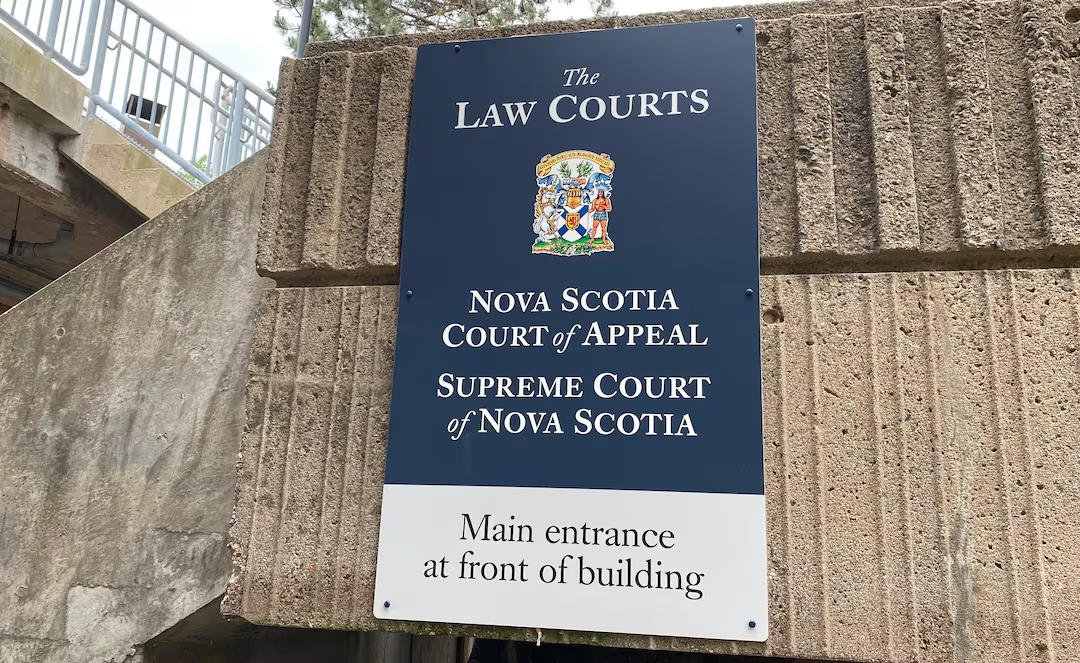
It wasn’t until earlier this year that Klayme’s legal team discovered the username discrepancy while working on appeal arguments. Last month, the Nova Scotia Court of Appeal acquitted Klayme of all charges.
“This is not a situation where an acquittal is entered because the Crown has failed to prove beyond a reasonable doubt the essential elements of an offence or an error during the trial made the verdict unsafe,” the appeal panel wrote.
“In these circumstances, Mr. Klayme is factually innocent of the offences. He should never have been charged, let alone convicted.”
Christian said he hopes Klayme’s case can raise awareness of the seriousness of wrongful convictions.
“Nobody deserves to go through what this young man went through,” he says.
Nova Scotia Justice Minister Scott Armstrong said earlier this month that the province will investigate the circumstances that led to Klayme’s conviction.
“I’m not sure how something like this can happen within the system,” Armstrong said.
Armstrong said on Aug. 6 that he plans on meeting with the Nova Scotia Public Prosecution Service to try to figure out what went wrong.
-
‘A subtle mistake’: How a single underscore led to an innocent Halifax man’s conviction
-
Province to investigate Brandon Klayme’s wrongful conviction
“The Nova Scotia Court of Appeal found that Brandon Klayme is factually innocent and should never have been charged or convicted. PPS accepts the Court’s decision and recognizes the serious consequences this outcome has had for Mr. Klayme,” the statement read.
“Once new information was obtained by police, the Crown provided it to the Court, supported its admission as fresh evidence, conceded the appeal and asked the Court to enter an acquittal. The Crown’s responsibility is not to preserve a conviction, but to ensure that justice is done.”
MORE TOP STORIES
-
Researcher studying Acadian wills says they were ‘an act of resistance’
-
‘It was unbearable’: Halifax tenants call for indoor temperature cap
-
West Chezzetcook celebrates the past and future of its culture on National Acadian Day
-
At Canada’s largest keel-boat regatta, advocates hope to see more women ride the wind
-
Adsum House ‘sickened’ by past misogynistic song made by N.S. cabinet minister, calls for his removal
ABOUT THE AUTHOR
