
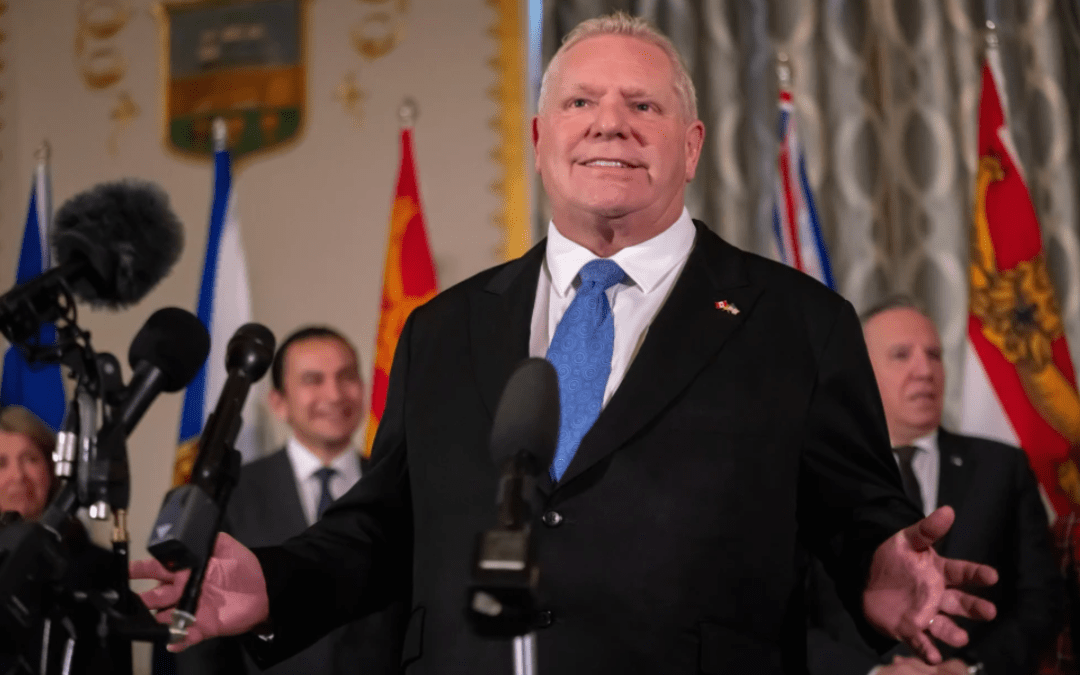
Ontario Premier Doug Ford said Canada is in an “economic war” right now and emphasized that no deal is better than a bad deal with Trump.
“It’s very challenging right now. I just sit back some days, and I am not the only one. Everyone in the world sits back. How can one person, one man, create so much turmoil around the world? Not just here in Canada but around the world. It is pretty staggering. So I can’t wait for the midterms,” Ford said.
The Supreme Court’s decision on Friday struck down tariffs that Trump had imposed on nearly every country in the world using an emergency powers law. Trump has now stated he will use a different, albeit more limited, legal authority to reimpose tariffs.
“It was a positive message from the Supreme Court,” Ford said, acknowledging the court’s ruling.
However, Ford noted that while most of Canada’s exports to the U.S. are covered by the United States-Mexico-Canada Agreement (USMCA), some tariffs are still taking a toll on certain sectors of Canada’s economy, particularly aluminum, steel, autos, and lumber.
Ford warned that Trump could scrap the free trade deal that is under review this year. He cited examples of other countries like Japan and the U.K., which rushed to secure deals with the U.S. but faced backlash from Trump.
“We’re going to be cautious,” Ford said, adding that many Republican seats will be up for grabs in November’s elections for control of the House and the Senate, including several in neighboring Michigan.
The premier also highlighted a recent House vote that rebuked Trump’s tariffs on Canada, a rare and largely symbolic move where Republicans joined Democrats over the objections of GOP leadership. The resolution seeks to end the national emergency Trump declared to impose the tariffs, though undoing the policy would require the president’s support, which is highly unlikely. The resolution next goes to the Senate.
“The walls are closing in on President Trump,” Ford said. “You saw him lose the vote and six Republicans crossed the floor with Congress and then you saw the Supreme Court.”
Ford emphasized that the tariffs are causing inflation, noting that people in the U.S. are feeling the economic crunch with rising prices for food and other goods.
“Down in the U.S., people are feeling the crunch. They don’t see the prices going down with food and other goods. That all has come down to the uncertainty that he’s put around the world and his number one customer in the world,” Ford said.
Trump recently threatened to impose a 100% tariff on goods imported from Canada over the country’s proposed China trade deal, intensifying a feud with the longtime U.S. ally and its Prime Minister Mark Carney.
Daniel Béland, a political science professor at McGill University in Montreal, noted that there is always a diplomatic risk for foreign politicians to criticize President Trump so bluntly and publicly, given his well-known sensitivity to criticism. However, Béland said Ford’s comments reflect widespread sentiment in Canada, where Trump is highly unpopular.
“Ford’s comments are consistent with what Canadians think. Trump is highly unpopular in Canada,” Béland said.
Despite the challenges, Ford remains focused on protecting Ontario’s economic interests and advocating for fair trade practices. He has encouraged other Canadian premiers to contact American legislators to highlight the economic uncertainty Trump is creating for both countries. Ford also plans to travel to the U.S. to meet with state governors in the coming months to discuss trade and economic issues.
In the meantime, Ontario is working to diversify its trade beyond the U.S. and attract businesses and investment to the province, focusing on sectors such as nuclear, manufacturing, healthcare, skilled trades, and mining.