
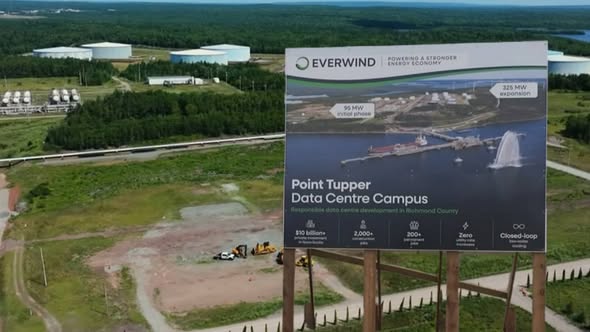
Tim Houston told Nova Scotians in June that AI data centres were far out in the future, and then EverWind picked up the phone. Now a $10 billion data centre is coming to Point Tupper, it will draw from the lake Port Hawkesbury drinks from, it will consume more than a tenth of the province’s power, and the Premier is calling it data sovereignty.
Let me lay out what actually happened, because the sequence matters more than any single announcement.
In June, Tim Houston said that AI data centres in Nova Scotia were so far out in the future that his government was not even discussing them, and he added that he would not commit to one unless the province could fully supply the energy without any risk to Nova Scotians. By September, EverWind had signalled interest in building one. By October 16, the Premier was standing in Point Tupper praising the project as a win for the province and announcing that construction had already begun, with site clearing underway and foundations planned before winter. When reporters asked him about the reversal, he blamed geopolitics and the federal government’s push for data sovereignty. NDP Leader Claudia Chender responded that the Premier’s word is not good enough, and she pointed out that he routinely changes his mind. That is a polite way of describing a government that announces a ten billion dollar industrial project after telling the public it was not even on the table, and then wraps it in the language of national sovereignty when the company on the other side of the lease is from America, a country that a growing number of Canadians now openly describe as an enemy.
.
Here is what the project actually is, stripped of the press release language.
EverWind Fuels is building the data centre, and Anthropic, the American company behind the AI Claude, has signed a twenty year lease for the first phase. This is Anthropic’s first data centre agreement in Canada. The campus will cover 18,600 square metres, with 95 megawatts coming online by late 2027 and another 325 megawatts arriving in 2028. At full build out the facility will draw 420 megawatts, which is roughly 13 to 14 per cent of Nova Scotia’s entire current generating capacity of about 3,000 megawatts.
.
The power arrangement is worse than the headline numbers suggest, because the renewable energy that is supposed to justify this project will not exist when the servers switch on. EverWind is building four onshore wind farms, but those farms are not expected to reach commercial operation until 2028, with the first wind energy not flowing until mid to late 2028 at the earliest. The data centre’s first 95 megawatt phase opens in late 2027. That means the facility will run on Nova Scotia’s existing provincial supply, powered by whatever that system is actually generating, for at least its first year of operation and likely longer before the wind farms come online to support it. EverWind says the grid operator (Nova Scotia Power) has studied the first phase and concluded it can handle the load, but the company has not explained what that load will do to ratepayers, and the NDP has already asked how the government intends to enforce the promise that nobody’s power bill will go up. A project that is sold as green and sovereign will spend its first year and more burning the existing system while the turbines are still being built.
.
That raises a question nobody in this government has answered: after their record, why should any Nova Scotian trust the company that runs the power grid?
.
Nova Scotia Power is a private monopoly and a subsidiary of Emera, and it was sold off by a Progressive Conservative government in 1992 as a way to get the provincial debt off the books. Since then the company has built a record that would make any ratepayer suspicious. Power bills in this province have risen by an average of $400 since 2021, and 43 per cent of Nova Scotians now say they are paying more than they can afford to keep the lights and heat on. For eight years in a row the utility has failed to meet its own reliability standards, and in 2024 there was an unplanned outage somewhere in Nova Scotia nearly every single day. The company asked for another eight per cent increase that would push its profits to $212 million by 2027, a 50 per cent jump in four years, and the regulator had to step in and force it to trim its spending because the request was so far out of line. Then there was the cybersecurity breach, which exposed the personal information of 280,000 customers, including social insurance numbers the company should never have been holding in the first place, and left people with estimated bills double and triple what they actually owed. The number of customers withholding payment because they no longer trust their own bills is now twice the normal rate. The NDP’s opening statement to the regulator put it plainly: Nova Scotians have no trust in Nova Scotia Power right now, and it is not hard to understand why.
.
The question nobody has answered is what happens when the power runs short and everyone wants it at once. EverWind says the data centre will cut back when the system needs the electricity, and that it will include battery storage to help. That is the whole answer the public has been given, and it does not tell anyone what actually happens on a cold February night when households and a 420 megawatt AI campus are competing for the same supply. There is no public document showing who gets priority, and the study the company relies on covers the first 95 megawatts only, not the full build. Nova Scotians are being asked to trust that the arrangement will work out fairly, from a utility with the record described above, on a promise nobody has put in writing where the public can read it.
.
Water is where this stops being a debate about rates and supply and becomes a question about health and the environment. The data centre draws its cooling water from Landrie Lake, which is the same lake that Port Hawkesbury and Point Tupper use for drinking water. EverWind says the draw is only about one per cent of the lake’s safe yield, but that number hides what actually happens to the water. This is closed loop cooling, which means the water is pulled out of Landrie Lake, run through the facility to cool the servers, and then put straight back into Landrie Lake. It goes back heated. Hot water is being poured into the lake that supplies the town’s taps, its showers, and its kitchens, and nobody has publicly explained what that does to the temperature of the water people are drinking or to what grows in it once it warms up.
.
What warm water does to a lake is not a mystery, and none of it is good for a drinking water source. Port Hawkesbury resident Craig Power, who has a technology background, told council that data centres can raise water temperatures for ten kilometres by as much as two degrees Celsius, which is a large change for a lake this size. Federal environmental assessment guidance is blunt about the mechanism, stating plainly that the release of heat into a lake is a form of pollution and that warm water alters local ecology. Warmer lake water is associated with the introduction of pathogenic organisms, including the Naegleria amoeba that thrives in warm freshwater, and with algal blooms that can clog water intakes and affect taste and odour. It can also change how the lake mixes through the seasons, which affects oxygen levels and the chemistry that a drinking water treatment plant has to manage. Every one of those is a cost and a risk that lands on the town and its ratepayers rather than on Anthropic.
.
Port Hawkesbury resident Aidan Pottie stood outside the announcement holding a sign that read “you can’t drink data,” and he explained that the lake is the town’s drinking water, shower water, and cleaning water, and that he simply does not think that is alright. Mayor Brenda Chisholm-Beaton has said that any data centre plan cannot jeopardize the main water supply, and Deputy Mayor Todd Barrett said he is all for economic development but not at the expense of the community’s water or its resources. Town council has asked staff to get answers from EverWind, and residents are already worried about wells drying up in the summer. Control over your own drinking water is the most basic kind of sovereignty there is, and Port Hawkesbury has not been asked whether it is willing to let an American firm warm up its lake so it can run its servers.
.
The jobs argument deserves the same scrutiny, because the numbers on the poster are not the numbers that will land in Cape Breton.
.
EverWind claims 2,000 construction jobs and 215 permanent operating jobs, but protest organizers point out that the high paying AI and executive positions will go to Anthropic rather than to Nova Scotians. Co-organizer Ashley Drodge said that the CEO will not be coming from Nova Scotia and will be coming from Anthropic instead, and she warned that the province cannot keep throwing its money back at the Americans. That is the sovereignty question in plain language, because a project that sends the engineering, the direction, and the profit south of the border while leaving the power bill and the watershed here is not independence in any sense a working person would recognize.
.
A Mi’kmaw consortium led by Membertou First Nation is negotiating a nine per cent equity stake in the data centre, and Membertou already holds a 51 per cent stake in the proposed wind projects. Chief Terry Paul has said the community has been working with EverWind since the company started operating in Cape Breton, and that may well be a genuine partnership. Equity, however, is not the same thing as free, prior and informed consent, and the public record does not show that the Assembly of Nova Scotia Mi’kmaw Chiefs has been consulted on the data centre itself. A minority stake in a project owned and directed by an American company is not sovereignty either, and it should not be sold to the public as though it were.
.
The question of who answers to whom is worth being precise about, because it is easy to get wrong in either direction. Anthropic is an American company, and it is subject to Nova Scotia and Canadian law for what it does on the ground in this province, including labour standards, environmental approvals, taxation, and federal privacy and impact assessment rules. What Nova Scotia law cannot do is control the company itself. The ownership, the board, the profits, the models, and the strategic decisions all sit in the United States, and no provincial regulator can direct any of that. The permits and the lease appear to sit with EverWind, with Anthropic as the tenant, which means the province’s regulatory grip is on the landlord rather than on the American company that will actually draw the water and consume the electricity. None of that gives Nova Scotia a vote on what the data is actually used for once the servers are running, and nothing in the lease gives the province a say if that work shifts toward purposes Nova Scotians would never agree to if anyone bothered to ask them.
.
What that means in practice is the part that should make Houston’s sovereignty claim collapse in his own mouth.
The company he is handing a twenty year lease to is Anthropic, and Anthropic’s Claude model was embedded in the Pentagon’s Maven Smart System, the targeting platform that was in use when a Tomahawk missile struck the Shajareh Tayyebeh elementary school in Minab, Iran, on February 28, 2026. At least 168 people were killed, and more than 100 of them were children under twelve, according to UN and Iranian officials. The proximate failure was a Defense Intelligence Agency database that still listed the school as a military facility, but the system that processed it was built to compress the time between identification and strike, and Anthropic’s model was inside it. Anthropic has fought the Pentagon over its red lines on mass surveillance and autonomous weapons, and the Pentagon designated the company a supply chain risk in retaliation, and that fight is real, but a fight over guardrails does not change what the guardrails failed to prevent. It also does not change the fact that the Premier of Nova Scotia is now leasing our water and our power to an American defense contractor’s AI supplier on a twenty year term and calling it Canadian sovereignty.
Sovereignty does not mean the data sits on Nova Scotian soil while the company, the model, and the ultimate legal authority all sit in California. Sovereignty does not mean telling Nova Scotians in June that data centres were far out in the future and then announcing one in October after EverWind picked up the phone. Sovereignty does not mean handing a twenty year lease to an American firm with a Pentagon contract and a kill chain in its recent history while refusing to release the due diligence, if any was done at all, and sovereignty certainly does not mean asking a community to let hot water be pumped back into its own drinking water lake while the Premier will not say who signed off on the arrangement or what they considered.
.
Canadians are already telling pollsters what they think of this arrangement. Postmedia-Leger found that 41 per cent of Canadians now consider the United States an enemy country, while only 22 per cent call it an ally, and among Canadians 55 and older that number rises to 51 per cent. A plurality of this country has looked south and concluded that the United States is not a friend. Tim Houston either has not noticed or does not care, and he is out there using the word sovereignty to describe a deal that points the other way entirely.
.
Then there is the part that tells you everything about how this government operates.
Two Halifax Examiner reporters, Jennifer Henderson and Joan Baxter, were physically accosted and removed by security from the October 16 announcement while they were trying to cover a ten billion dollar public policy story. Tim Houston and the local members of Parliament were in the room, and none of them has condemned it. The publisher of the Halifax Examiner has written an open letter calling on them to apologize, and EverWind has claimed it was a private event, which it plainly was not. A government that throws reporters out of a public announcement is not defending sovereignty either, because the public cannot consent to a deal it is not allowed to see reported.
.
This is the same pattern you have watched play out for years. Houston appointed himself Minister of Energy and removed cabinet oversight from resource decisions, he passed Bill 193 so that landowners who refuse drilling access can be fined $100,000 and jailed for two years, and he has blocked or ignored constituents who asked him questions. When a court struck down one of his fines against a veteran for walking in the woods, he said the government would do it again if necessary. Now he is fast tracking an American AI campus onto a system that Nova Scotians already do not trust, and he is daring anyone to stop him.
.
Protesters gathered in Halifax on October 17, and more are planned for November 7 in Kentville, Sydney, Halifax, and Port Hawkesbury. If you live near Point Tupper, ask EverWind and ask your MLA what due diligence was done on Anthropic before the lease was signed, what temperature the returned water will be when it goes back into Landrie Lake, and how many years the data centre will run on the provincial system before the wind farms meant to power it are actually online. If you live anywhere in this province, ask why a Premier who said data centres were far out in the future is now fast tracking one on our drinking water and calling it sovereignty. If your MLA has ignored you before, you already know what to do with this.
.
Who is Tim Houston really?
Tim’s War on Democracy.
Open letter to MLAs. I encourage anyone reading this to write their own.
My third open letter to Michelle Thompson after she blocked me for asking questions.
The full fire sale: why Houston is handing this province to foreign billionaires.
The math: why I live in a van and what this government refuses to fix.