
Carney says there has been ‘significant progress’ on an agreement with the Americans
From CBC NEWS


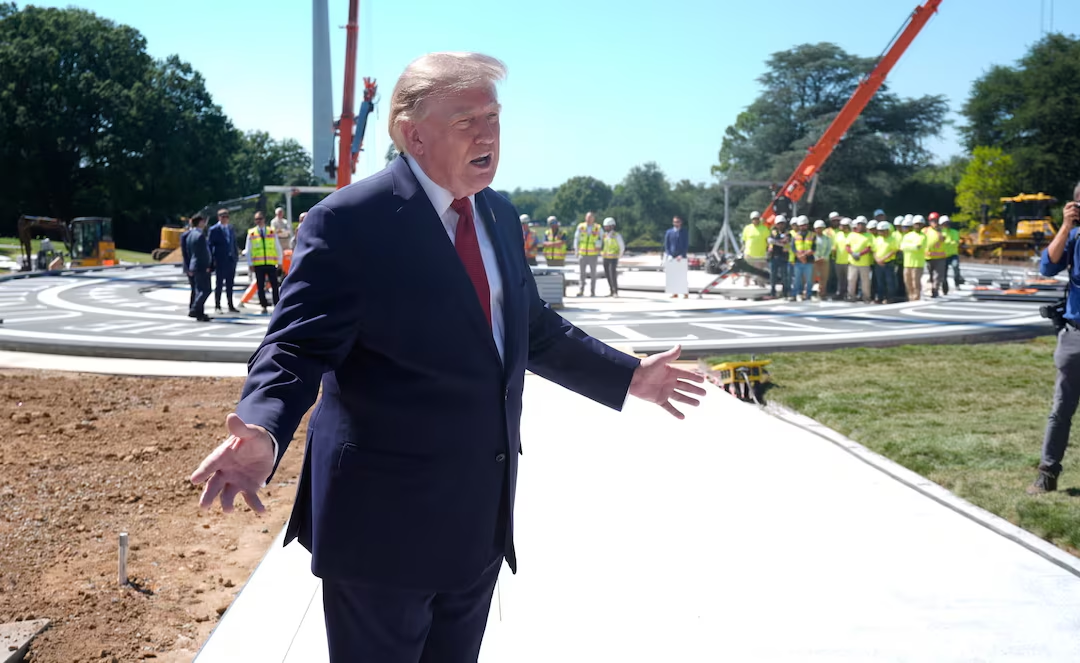
U.S. President Donald Trump says he has brokered what he called “a very good deal” with Canada that will work out well for both countries, while giving few details on what exactly has been negotiated.
Trump said on Wednesday that farmers and manufacturers in particular are going to be “thrilled” with what he’s agreed to do with Canada.
He said unspecified Canadian tariffs on U.S. goods “are going to be totally eviscerated, down to zero.”
The vast majority of U.S. products already trade into Canada tariff-free, but Ottawa has levied some retaliatory tariffs on U.S. autos, steel and aluminum imports since the outset of the trade war.
WATCH | Trump says deal is good for U.S. farmers:

U.S. President Donald Trump says Canada and the U.S. have reached a ‘very fair deal’ for both countries, after pausing threatened 50 per cent tariffs on a broad range of Canadian goods. Trump says tariffs on U.S. farm goods are ‘going to be eviscerated down to zero,’ when the deal is finalized.
Canada also has tariffs on some dairy imports that exceed a set quota. But American producers do not export enough dairy to meet Canadian tariff rate quota thresholds.
Still, Trump said what’s been negotiated is “great for our farmers.”
“Our farmers will no longer be held up, because they were being hurt very badly by Canada,” Trump said.
Trump said the U.S. has agreed to readjust its tariff rates on Canadian autos but didn’t specify by how much.
The current headline tariff rate is 25 per cent on Canadian automobile imports, a levy that caused significant economic dislocation, plant closures and lost jobs, particularly in Ontario, Canada’s industrial heartland.
“They were paying a high number, we’re reducing it a little bit,” Trump said of auto tariffs. “You gotta give something.”
While there are outlines of an agreement, Trump said that it’s “still subject to finalization of documents.”
Carney sees ‘significant progress’
Prime Minister Mark Carney, meanwhile, said in his own statement on social media there had been “significant progress.”
“Canada entered these discussions with the best overall trade terms. We are now moving towards an agreement that reinforces that Canadian advantage, including by securing the best terms in each of Canada’s most important strategic sectors and providing greater certainty about our future trading relationship,” Carney said.
Canada-U.S. Trade Minister Dominic LeBlanc met with U.S. Trade Representative Jamieson Greer in Washington on Wednesday morning for more talks.
WATCH | Trump pauses tariffs:

U.S. President Donald Trump has paused 50 per cent tariffs on Canada, saying the two countries have reached a new trade deal that just needs to be finalized. In a statement, Prime Minister Mark Carney said ‘substantial progress has been made.’
Speaking briefly to reporters on his way out of the roughly 30-minute long discussion, LeBlanc answered a question about whether Canada’s supply-managed dairy sector, long targeted by U.S. negotiators, will be affected by the terms of this prospective agreement.
“The prime minister was very clear, we need to protect supply management. We need to ensure that the supply management regime remains entirely intact and I’m confident that that’s the case,” LeBlanc said.
In a later social media post, LeBlanc said he is “working collaboratively towards a finalized agreement” with the Americans.
“Efforts remain ongoing,” he said.
Sources told CBC News that Canadian officials will brief premiers on the state of these trade talks later Wednesday.
-
Where do Canada-U.S. trade negotiations stand? Here’s a sector-by-sector breakdown
Trump announced late Tuesday he was pausing for three days the threatened 50 per cent tariffs on nearly $30 billion worth of Canadian goods, saying there had been a breakthrough in the negotiations.
According to the text of the proclamation Trump signed, the U.S. is backing down because “Canada has expressed a commitment to remove discriminations or unreasonable and unequal impositions” related to American autos, dairy and liquor. That is a reference to the retaliatory measures Ottawa has taken since Trump first launched his trade war last year, as well as Canada’s supply-managed dairy sector.
On Wednesday, Greer framed the forthcoming deal as a win-win.
“We’ve reached an agreement that will not only continue to protect American workers, American jobs, American supply chains, but really strengthen the North American economy and create a situation where North America will continue to be an energy powerhouse, a manufacturing powerhouse,” he told reporters gathered outside his office.
Few details
The details of what exactly has been brokered — if anything — are scant.
Neither side released any documents stating what each country could give up in return for some concessions.
Beyond Greer’s assertion that there will be changes to some Canadian policies, Trump alluded to a possible revival of the Keystone XL pipeline, a long-defunct project that could carry oil from Alberta to the U.S. Gulf Coast. Trump already signed an executive order in April authorizing the construction of a similar cross-border pipeline.
WATCH | Trump’s order revives parts of pipeline:

U.S. President Donald Trump has signed an order authorizing a proposed project to transport Canadian oil across the border as part of an effort to revive parts of the cancelled Keystone XL pipeline. South Bow, the Canadian company behind Keystone XL, is partnering with U.S. company Bridger Pipeline on the proposed project.
The Americans have long demanded U.S. liquor be put back on the shelves of provincially run stores, ending a boycott that has been devastatingly effective. The Trump administration is also pushing for Canada to remove its retaliatory tariffs on U.S. autos and to change how the supply-managed dairy sector allocates quotas.
LeBlanc, meanwhile, has pushed for the U.S. to scrap the threatened 50 per cent levies, called the Section 338 tariffs. He also wants the country to lower the existing Section 232 fees on industrial products like steel, aluminum, autos and lumber.
Carney said his government is working on a deal that will “address outstanding trade issues and deliver greater certainty and real benefits for Canadian businesses, workers, farmers and families.”
ABOUT THE AUTHOR
